
TThen yoga is perfect for you. With regular practice, flexibility gradually improves over time. Yoga can also help develop stability, strength, balance, and awareness — both physically and mentally.
Yin Yoga can be especially supportive alongside more active styles, helping improve mobility and release tension in the joints and connective tissues.
We teach functional yoga, recognizing that every body is different. Our skeletons, tissues, physiology, temperament, and life experiences all influence how movement feels and functions for us individually.
If a pose does not work well for your body, we will help you find an alternative approach or variation that supports the intended benefit in a safe and sustainable way.
We offer modifications and alternative poses as needed. Always let the teacher know if you have an injury and seek professional medical advice where appropriate.
We are always happy to answer questions and help you adapt your practice safely.
Practicing yoga in a heated room can be physically demanding. If you are pregnant and new to hot yoga, we recommend joining a pregnancy yoga class and beginning hot yoga after your baby is born.
If you already have an established hot yoga practice and are accustomed to the heat, please let us know. From the second trimester onward, students with a healthy pregnancy may continue practicing with appropriate modifications and guidance.
Yin Yoga, Restorative Yoga, and non-heated practices are generally suitable throughout pregnancy, though we always encourage students to inform the teacher beforehand. In Eindhoven, one of our former students runs Happy Birthing pregnancy yoga class
Modern life often keeps us in a constant state of activity and stimulation. While exercise and healthy habits are important, rest and relaxation are equally essential for well-being.
Yoga offers practices that help calm the nervous system, regulate the breath, and create space to slow down. Relaxation is practiced throughout class and especially during Savasana — the final resting pose at the end of practice.
We also offer Restorative Yoga classes with a stronger focus on deep rest, release, and nervous system recovery.
We teach functional yoga, meaning we recognize that every body is unique. Our structure, physiology, history, mindset, and life experience all influence how movement feels and functions for us individually.
Rather than asking you to perform a posture to “look” a certain way, we encourage curiosity:
What is the purpose of this pose?
What am I feeling?
How can I make this practice work for my body?
We work with you to help find safe, effective, and sustainable ways of practicing. Diversity in movement and posture practice can help support long-term mobility, resilience, and well-being.
We use invitational and non-coercive language and respect that every student arrives with their own experiences, history, and relationship to their body.
Rather than assuming what someone should feel or do, we encourage students to listen to themselves and make choices that feel supportive and appropriate for them in the present moment.
Sports and exercise can be deeply beneficial, especially when you enjoy them. Yoga also develops strength, mobility, balance, and endurance, but places additional emphasis on the relationship between movement, breathing, awareness, and the nervous system.
Rather than only training the body outwardly, yoga also encourages inward awareness, self-regulation, focus, and connection with oneself. Yoga can be a valuable complement to all forms of sport and physical activity.
For more information, read How yoga helps Elite Athletes (by our yoga therapist Natasha, published in Eindhoven Sport, May 2017).
A skilled teacher understands that they are guiding people, not simply teaching postures.
Through movement, breath, awareness, and careful observation, a teacher can support students in developing a deeper relationship with their body and mind. Yet yoga remains a personal practice—ultimately, you are your own best teacher.
We encourage students to practice with curiosity, self-awareness, and compassion rather than comparison or performance. Over time, yoga can help you cultivate greater understanding, resilience, and agency in your own health and well-being. To explore this further, read Natasha’s article ‘How do I feel?’.
Yoga can support overall health, resilience, and quality of life, though it is not a cure-all.
By working through the body, breath, nervous system, and awareness practices, yoga offers a holistic approach to supporting physical, mental, and emotional well-being. Over time, many people find that yoga helps them cultivate greater balance, self-awareness, and self-compassion.
The Original Hot Yoga sequence is a traditional 26-posture and 2-breathing exercise practice taught in a heated room. Many people also know this style as “Bikram Yoga.” The sequence itself grew out of the B. C. Ghosh lineage and is considered a modern development within Hatha Yoga.
At Hot Yoga Eindhoven, we teach the practice through a functional, therapeutic, and trauma-sensitive approach, offering modifications and guidance to support different bodies, abilities, and levels of experience.
We view yoga less as a collection of separate styles and more as a range of practices designed to support balance in body and mind.
Our classes include Original Hot Yoga, original in-house Hatha Yoga-based programs, Flow classes, Pilates, Yin Yoga, restorative practices, breathwork, and meditation-based approaches rooted in the Krama Method and the broader Krishnamacharya tradition.
We also acknowledge the wider philosophical roots of yoga, including the traditional eight limbs of yoga, which extend far beyond physical posture practice.
For the full range of our offerings visit the Our Classes page.
Traditional yoga, as described in the Yoga Sutras of Patanjali, is often referred to as aṣṭāṅga yoga — meaning “eight limbs” or interconnected aspects of practice (not to be confused with the modern Ashtanga Yoga system popularized by Pattabhi Jois). These include ethical foundations, physical practice, breathwork, concentration, meditation, and deeper states of awareness. Rather than a rigid ladder, the eight limbs can be understood as a holistic system supporting how we move, breathe, focus, relate, and live.
In many modern yoga classes, students are most familiar with āsana (physical postures) and prāṇāyāma (breath practices), though traditional yoga ultimately integrates all aspects of practice together.
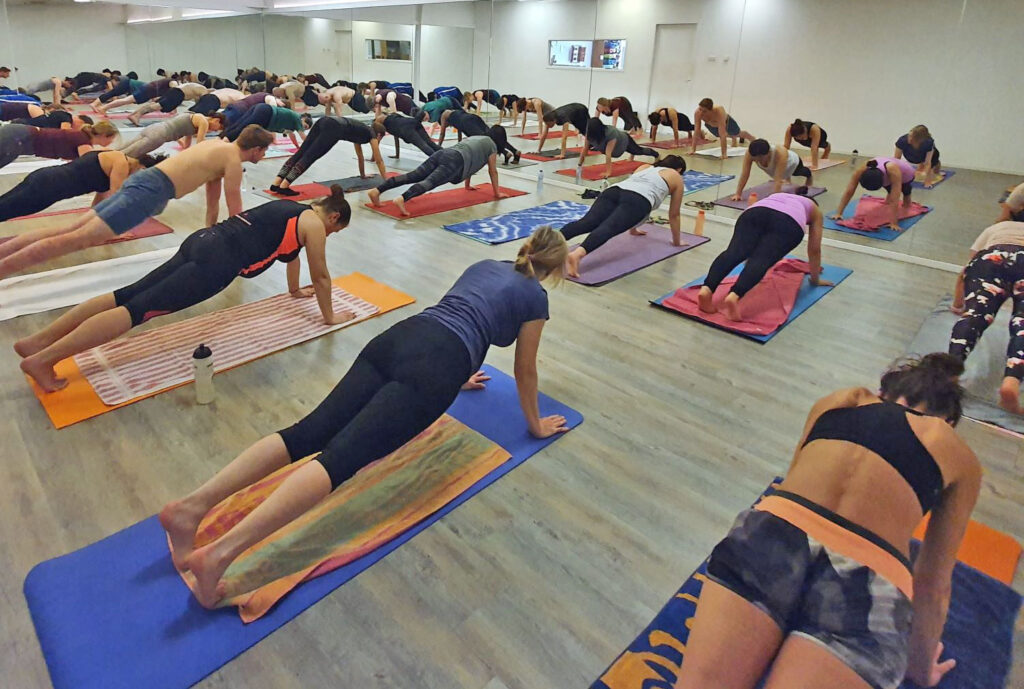
The 8 ‘limbs’ or components of Yoga are:
1 – yama, how we relate to others and the world around us.
2 – niyama, how we relate to ourselves.
3 – āsana, practice of physical yoga postures.
4 – prāṇāyāma, breath and energy practices.
5 – pratyāhāra, turning attention inward.
6 – dhāraṇā, concentration and focus.
7 – dhyāna, sustained awareness; meditation.
8 – samādhi, absorption, connection, inner stillness.